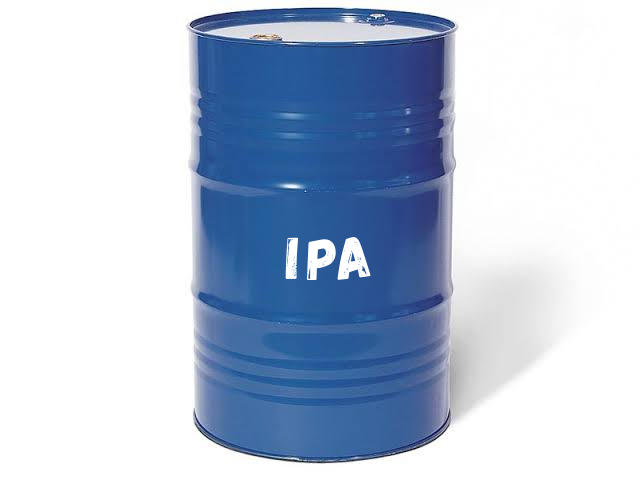
Specification
Packaging Type :- PVC Drums
Packaging Size :- 190 kg
Boiling Point :- 82.5 °C
Density :- 790 kg/m3
Packaging Type :- PVC Drums
Packaging Size :- 190 kg
Boiling Point :- 82.5 °C
Density :- 790 kg/m3
Isopropyl alcohol (IUPAC name propan-2-ol and also called isopropanol or 2-propanol) is a colorless, flammable organic compound with a pungent alcoholic odor.
Isopropyl alcohol, an organic polar molecule, is miscible in water, ethanol, and chloroform, demonstrating its ability to dissolve a wide range of substances including ethyl cellulose, polyvinyl butyral, oils, alkaloids, and natural resins. Notably, it is not miscible with salt solutions and can be separated by adding sodium chloride in a process known as salting out. It forms an azeotrope with water, resulting in a boiling point of 80.37 °C and is characterized by its slightly bitter taste.
Isopropyl alcohol, also known as rubbing alcohol, has many uses, including:
The primary method of production of isopropyl alcohol is by combining water and propene in a reaction called hydration. It can also be produced by the hydrogenation of acetone. In both the processes of the production of isopropyl alcohol, separation is required. The product isopropyl alcohol is required to be separated from by-products like water. This is done by the process of distillation. In the case of simple distillation, isopropyl alcohol forms a solution that is 87.9% by weight isopropyl alcohol and the rest is water. This is an azeotropic solution and has a common boiling point of the mixture. Thus, to obtain pure isopropyl alcohol, we need to carry out azeotropic distillation. This process is done by using azeotroping agents like cyclohexane and di-isopropyl ether. The body also produces small amounts of isopropyl alcohol in the process of diabetic ketoacidosis.